0:01
Today we want to use the example of a
0:04
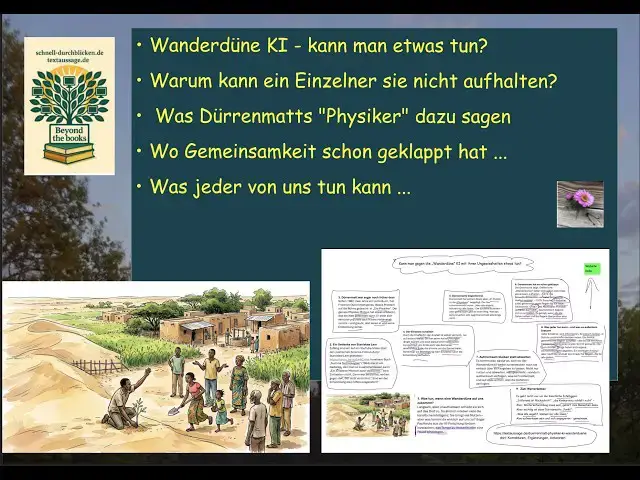
shifting sand dune to show the dangers
0:07
involved and how to deal with them. You
0:11
can clearly see here that people's
0:14
everyday lives are threatened and this
0:18
dune keeps moving forward if you don't
0:21
stop it. And that is what we are going
0:24
to look at more closely now. We are
0:26
simply applying this concept to
0:28
artificial intelligence, which worries
0:31
many of us because we don't know what
0:33
kind of problems might arise. One thing
0:37
is clear: an individual cannot stop it,
0:40
but surprisingly, Dürrenmatt, the
0:43
writer, can give us a hint with his
0:45
play "The Physicists" and at least show
0:48
us a direction. It is also about
0:53
showing where common efforts have
0:56
already worked in managing such dangers
0:59
. And in the end, it is about what each
1:03
of us can do, even in other areas that
1:05
have nothing to do with artificial
1:07
intelligence at all. So it is about
1:10
what can be done against the "shifting
1:12
dune" of AI and its uncertainties. Down
1:15
here on the left we have the image
1:17
again, and we have already described
1:19
the situation. The interesting thing
1:22
now is that there are efforts to slow
1:25
down the pace of AI development or even
1:28
take a break. And we have just seen a
1:32
video about a significant science
1:35
fiction author from Poland, Stanislaw
1:38
Lem. And here we have the video, we
1:41
will link it as well, everyone can take
1:43
a look. He dealt extensively with
1:47
technological questions in a book and
1:51
formulated a thought there that can be
1:55
summarized as: an individual can
1:58
abstain, but a civilization, as a whole
2:02
, cannot. Because those who abstain
2:06
lose to those who do not. And hence the
2:09
question: are we helplessly at the
2:11
mercy of this development? Anyone
2:14
familiar with German literature lessons
2:17
will probably remember that another
2:20
writer also dealt with this in a
2:23
literary way. He published the play "
2:27
The Physicists," featuring the
2:30
brilliant physicist Möbius, who
2:32
discovered something that could
2:35
endanger the world. Yes, just like new
2:39
things in AI, for example. And he
2:43
pretends to be crazy, retreats into a
2:46
sanatorium, and believes he and his
2:49
discovery are safe there. But what Lem
2:54
said is confirmed; the individual fails
2:57
because there is a chief physician in
3:00
this institution who is crazy herself,
3:03
or she could simply be a competitor
3:05
thinking with a clear mind. I am trying
3:09
to get my hands on this invention. She
3:12
has long since copied the scientist's
3:15
notes and is building a global
3:16
corporation, and in the end, we are
3:19
left with the image of an irradiated
3:21
Earth. That was the concern back then
3:24
when Dürrenmatt wrote the play, that
3:26
things were moving more and more toward
3:29
nuclear power and nuclear weapons, and
3:31
then we would end up with an irradiated
3:33
Earth pointlessly circling the sun, and
3:36
this seems to be the confirmation. No
3:38
individual can stop this development.
3:42
But that would, of course, not have
3:44
been a reason for us to make this video
3:46
, because then we couldn't change
3:47
anything anyway. However, Dürrenmatt
3:52
developed a counter-formula; he added
3:55
21 points to the play, and the decisive
3:59
one is: What concerns everyone can only
4:03
be solved by everyone. The individual
4:08
fails, but together there is a way. But
4:11
Dürrenmatt doesn't say how that is
4:13
supposed to work concretely. He only
4:16
names this principle. That one should
4:19
observe. Now let's get to the good news
4:22
and the possibilities. Working together
4:26
, quite a few things have actually
4:27
worked out. It is also worth doing a
4:29
little research yourself on that.
4:32
Dangerous shifting dunes, as we have
4:33
captured in this image, have already
4:35
been stopped together several times.
4:38
1972 there was a biological weapons
4:42
convention, which also covers atomic,
4:44
chemical, and biological weapons. In
4:48
this case, the biological weapons were
4:50
at least banned worldwide. Then 1975
4:56
researchers gave themselves rules for a
4:59
new gene technology, right? You could
5:02
research for yourself what that is all
5:04
about. And in 1987, at least the
5:07
parents will remember this, people
5:10
focused primarily on CFCs, the
5:12
hydrocarbons, if I remember correctly
5:14
—I don't quite know it myself anymore
5:17
, uh—people dealt with this because
5:20
the ozone hole, right, was getting
5:22
bigger and bigger, which meant that the
5:25
sun's radiation was becoming more and
5:28
more dangerous, and this ozone hole
5:30
then began to close. These are also all
5:33
research pointers here where you can go
5:35
look things up. This means that a lot
5:38
can be achieved when the danger is
5:40
recognized and the rules are verifiable
5:43
; what it looks like now in the year
5:45
2026 with biological weapons, atomic
5:47
weapons, and so on. It is best to
5:50
discuss that in class and then consider
5:53
what can be done concretely, because in
5:55
some respects global conditions have
5:57
changed and some things have become
5:59
more open and also more dangerous again
6:01
. Let's move on to number 7. That is
6:05
exactly the point we wanted to address,
6:07
which can also be done very well in the
6:09
classroom. Stay attentive instead of
6:12
waiting. So it is a matter of neither
6:14
hiding from this AI shifting dune nor
6:17
simply letting it happen to you. Don't
6:20
just use it and wait to see what
6:21
happens; instead, pay close attention
6:23
to what is developing. We are doing a
6:26
lot on our channel, and there are other
6:28
channels that are much more specialized
6:30
in artificial intelligence, and we can
6:33
certainly provide some URLs for those,
6:35
while keeping an eye on everything that
6:37
reduces the risks. And then, let's
6:41
address the question here a bit more
6:44
concretely: what can everyone do, and
6:46
what else is needed? As we have already
6:50
said, get informed, use AI critically,
6:53
and try to understand what it can and
6:55
cannot do. Then you won't immediately
6:59
feel afraid when people pretend that AI
7:01
could threaten us one day. It has no
7:04
reason whatsoever to threaten us
7:06
because it has no feelings or
7:08
intentions of that kind; those would
7:11
have to be programmed into it, which is
7:13
why we must ensure that we focus on the
7:16
people who ultimately program and
7:18
monitor the AI. So, talk about it in
7:20
school and in the family. It is also,
7:24
of course, up to politics to create
7:25
common rules. The EU has already done
7:28
quite a bit in this regard. We just
7:31
have to see how practical that is, and
7:34
the tech companies have also developed
7:37
a certain awareness of the problem. And
7:41
that is why there are special safety
7:42
rules there as well. And if everyone
7:45
pays attention and watches out, then
7:47
there is, of course, a possibility that
7:49
it will be implemented better. An
7:51
important task, but according to
7:53
Dürrenmatt, this is no substitute for
7:55
rules that apply to everyone. In
7:58
closing, we just want to point out that
8:01
what we have discussed here does not
8:03
just apply to artificial intelligence;
8:06
there are many other areas one could
8:08
discuss in class where scientific
8:10
progress creates opportunities that
8:13
also bring problems with them. But it
8:16
also holds true that standing still is
8:18
a step backward; the competition never
8:20
sleeps, and it is simply part of being
8:23
human to always want to push boundaries
8:25
and develop new things. It is just
8:28
about this one point that Dürrenmatt
8:31
formulated quite well, at least. What
8:34
concerns everyone can only be solved by
8:37
everyone, so stay alert, get involved,
8:39
and do it together. We hope that we
8:43
have been able to contribute a little
8:45
bit here to how to deal with such
8:46
dangerous developments that can become
8:48
like a migrating dune that literally
8:50
rolls over you. We will post
8:54
corrections, potential additions,
8:56
answers to questions, and ideas on this
8:59
page here. And as always, we will
9:02
insert a button up here so that you can
9:04
click on it quickly and reach your
9:06
destination. We naturally look forward
9:09
to your reactions, and we hope together
9:11
that we can get these and other
9:13
shifting dunes under control or keep
9:15
them in check, and we wish us all much
9:17
success in doing so. M.