0:01
Today we want to show you once again how
0:03
to quickly get to grips with a poem.
0:08
It's by Neffel Kumar and is titled "to
0:10
home," and it deals with the exciting
0:13
question: can you come home from home?
0:17
And we'll be doing the whole thing in a
0:19
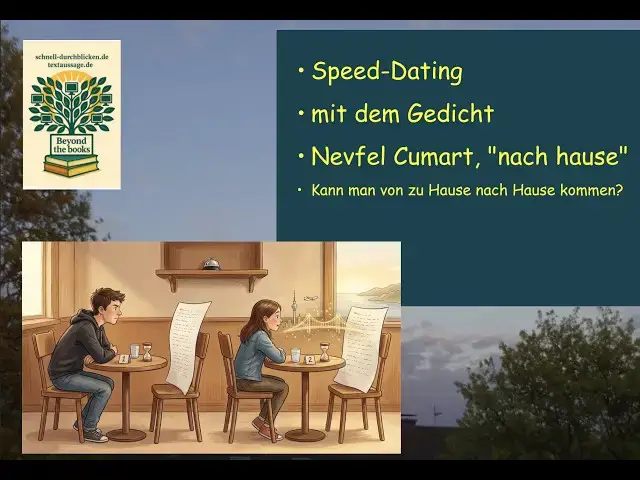
speed-dating format. You know how it
0:22
works: you sit across from each other,
0:25
only in this case, your partner—your
0:27
partner in understanding—is a poem.
0:31
And as you can see, this girl is already
0:33
looking quite happy; that’s our goal,
0:35
and we want to get this boy to that
0:37
point too, so we'll show you the best
0:41
A brief word on our approach: the poem
0:44
is still under copyright, which means
0:47
we’ve only highlighted the parts that
0:50
are crucial for understanding it, and on
0:53
the second page, we’ll show you how to
0:57
describe the content.
1:00
We’ve already said a few things about
1:03
So, let's move on to the title, which is
1:06
"to home," written in lowercase, and
1:09
that is usually something nice,
1:11
associated with good expectations, and
1:14
the first four lines are also still
1:19
It’s about returning to Berlin, and
1:21
that’s why we’ve highlighted "over
1:25
That means the plane is preparing to
1:27
land. No problems with the poem so far,
1:30
and one remains curious about what it’s
1:35
Lines 5 through 10 then change the
1:38
situation, because suddenly he has a
1:41
thought that is quite heavy, as he asks
1:44
himself: is it actually possible to come
1:48
home from home, to have two homes?
1:53
And here, there’s naturally a chance for
1:55
everyone to start considering if they’ve
1:58
experienced such a situation in their
2:00
own life—having an earlier home from
2:02
childhood, for example, and then one
2:07
That is certainly something one can
2:09
easily relate to, but the poem takes a
2:15
In the third section here, it becomes
2:21
Let's connect this here, because the
2:23
lyrical self has the feeling that his
2:26
body forms a kind of bridge.
2:29
Before him lies Berlin, his new home,
2:32
and behind him, beyond Europe, his old
2:36
home—that could be Turkey, for instance
2:39
—which fits the bridge metaphor, since
2:42
it is also connected to the actual core
2:45
of Europe, mainland Europe, by an
2:48
elaborately designed bridge, and the
2:51
interesting thing is that there is a
2:54
double emotional state here.
2:58
On one hand painful, which can perhaps
3:00
be understood as leaving the old
3:03
homeland behind, but also almost
3:05
comforting in how it relates to the
3:09
This means he has the feeling that there
3:11
is also a connection between the old and
3:16
The ending is especially important,
3:20
because his body doesn't just form a
3:23
bridge, but carefully lies upon it, so
3:27
that even the Asian peninsula—
3:30
presumably meaning Turkey—is covered,
3:33
and in the process, his dreams are lost
3:40
This means one gets the feeling here
3:43
that this bridge establishes a
3:45
connection, but also obscures the old in
3:48
a certain way, so it is a dual statement
3:54
Yes, here we will start by showing how
3:57
you can write a poem description.
4:01
That comes up frequently these days. The
4:05
problem is that poems usually don't
4:08
contain a plot in the normal sense that
4:11
you could simply summarize.
4:14
Recounting it, of course, is not
4:17
But you can always say what the lyrical
4:19
I does, what it perceives, thinks, feels
4:25
In the introductory sentence, one could
4:28
say that in the poem, a lyrical I
4:30
arrives in Berlin by plane and feels
4:33
that it is connecting two homelands
4:35
within itself, which would
4:37
simultaneously be the theme: how does it
4:40
work to connect two places as each being
4:45
Then we come to the first part.
4:49
The lyrical I is in its final approach—
4:52
we'll correct that now—describes
4:54
arriving in Berlin and then reflects on
4:57
coming from home to home.
5:00
You can see here that you can certainly
5:03
You don't usually do that in a summary
5:06
of a short story. So there are two
5:09
places that it can call home.
5:12
In the third part, it feels its body
5:14
stretching across Europe and over the
5:19
It perceives this as painful and at the
5:22
same time almost comforting, and at the
5:24
end it describes how it gently covers
5:26
the Asian peninsula, its old homeland.
5:30
In doing so, it realizes that its dreams
5:34
With that, we now have an overview of
5:37
the entire poem once again.
5:39
Now let's look at the summary, the
5:42
result of this speed-dating.
5:46
The poem shows a person with two
5:48
homelands: Berlin as the new home, and
5:50
likely Turkey as the old one.
5:54
At the moment of landing, the lyrical I
5:56
naturally senses that it is connecting
6:01
Its body becomes a bridge.
6:04
That hurts and comforts at the same time
6:08
And in the end, the new life gently
6:10
settles over the old.
6:12
That lessens the pain, but it comes at a
6:15
cost: namely, the dreams tied to the old
6:20
So it is always painful, though it
6:21
naturally fades as something recedes
6:25
In short, having two homes is a gain,
6:28
but not one without a price.
6:32
We always suggest considering: what does
6:34
all of this actually have to do with me
6:37
Even without migration, that might be
6:41
Is this something you recognize?
6:43
Moving house, a new school, parents in
6:45
two apartments, the place where
6:46
grandparents live, perhaps of great
6:48
significance from childhood.
6:51
Where am I actually at home, and is it
6:53
just a place, or do dreams, for example
6:57
When I settle into something new, what
7:00
do I gently place over the old? So, what
7:02
becomes more important?
7:04
And which dreams might get left by the
7:06
wayside in the process?
7:08
But they still break through every now
7:09
and then. Conversely, perhaps I
7:11
understand people with two homes better
7:14
if I know they sometimes feel like a
7:18
Sometimes painful, but at other times
7:20
comforting in the sense of covering over
7:23
And as a takeaway: home is not just a
7:26
point on a map, but also something you
7:28
carry within you and connects you.
7:33
And then, in speed dating, there is
7:35
always the bell, and the second date
7:37
could be that if you want to continue,
7:40
you will find our more detailed page,
7:42
guiding you stanza by stanza and
7:44
providing a comparison with another poem
7:48
There, the bridge threatens to break.
7:50
Here it holds, and that is the link you
7:53
don't have to write down.
7:55
We’ll just put that on a button that we
7:59
always place up here.
8:02
And there you'll find potential
8:04
corrections, additions, answers to
8:07
questions, and finally, a tip for the
8:10
content summary, which can play a major
8:13
role. Pay attention to the verbs.
8:16
Locates, reflects, feels, senses, covers
8:21
If almost every sentence has such a verb
8:23
, you are on the right track regarding
8:25
the lyrical I. The interpretation—that
8:27
is, what it all means and what sense it
8:30
makes—comes only afterward in that right
8:32
column we have displayed.
8:35
We hope this speed dating has led to a
8:38
better understanding of this poem, and
8:41
that it's not just the girl at the front
8:44
looking happy, but the boy too.
8:47
That is, in any case, what we wish for